

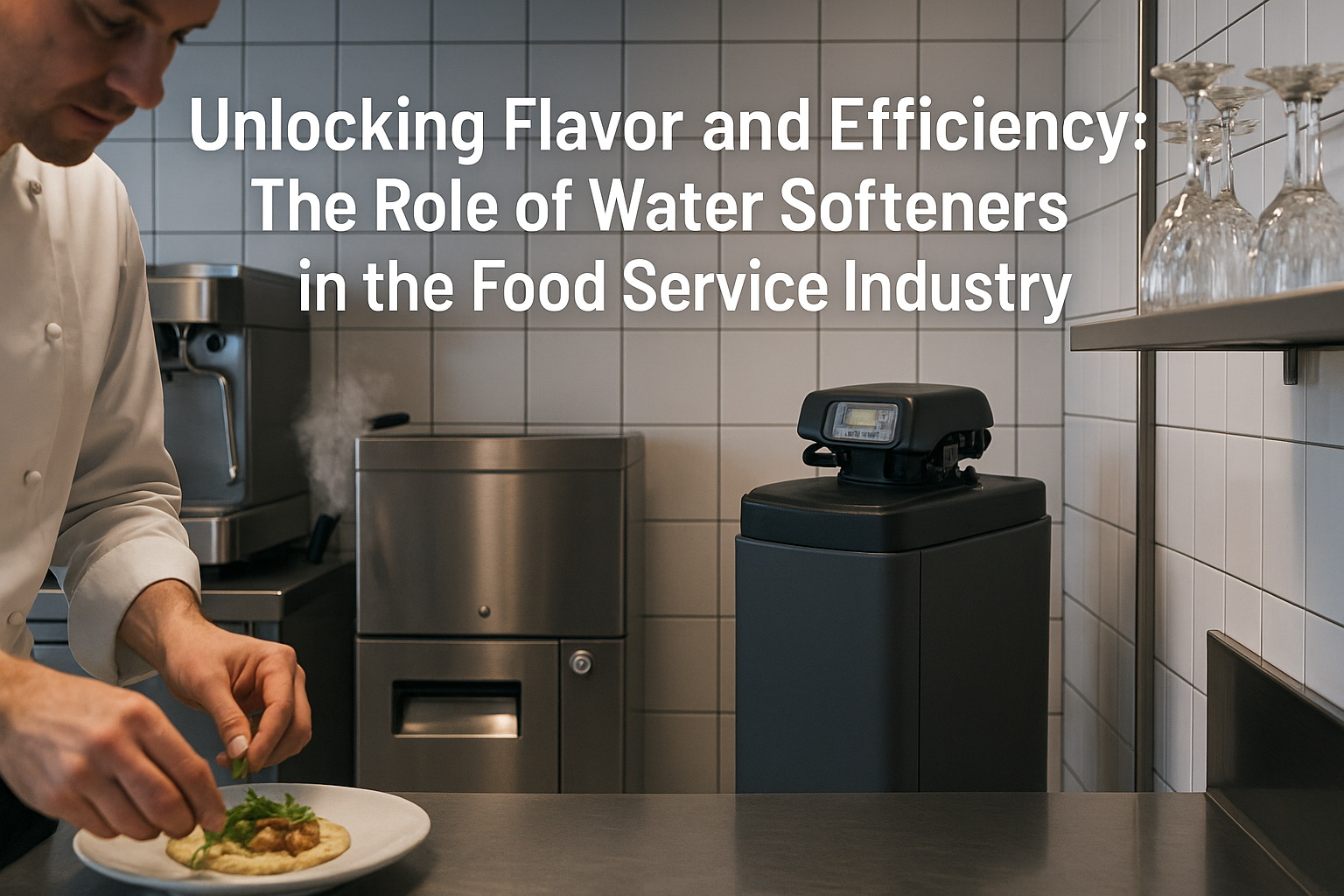

Unlocking Efficiency and Flavor: The Impact of Water Softeners in the Food Service Industry
In the UAE’s dynamic food service landscape, water quality plays a pivotal yet often overlooked role in operational excellence. With the region’s naturally hard water containing high mineral concentrations, restaurants and commercial kitchens face unique challenges that directly impact equipment performance, product quality, and ultimately, the bottom line.
As sustainability initiatives like UAE Vision 2031 and Dubai’s Single-Use Plastics Policy reshape industry standards, forward-thinking establishments are recognizing that water treatment solutions—particularly commercial water softeners—represent a strategic investment that addresses multiple pain points simultaneously.
Table of Contents
- Understanding Water Hardness in the UAE Food Service Context
- The Hidden Costs of Hard Water in Commercial Kitchens
- How Water Softeners Enhance Food and Beverage Flavor Profiles
- Equipment Longevity: The Maintenance Advantage
- Implementing Water Softening Solutions: ROI and Best Practices
Understanding Water Hardness in the UAE Food Service Context
The UAE’s municipal water supply, largely derived from desalination processes, typically contains significant mineral content—particularly calcium and magnesium ions. While meeting safety standards, this hard water creates substantial challenges for food service operations across Dubai, Abu Dhabi, and other emirates.
Water hardness in the UAE frequently exceeds 180 ppm (parts per million), categorizing it as “very hard” by international standards. This natural characteristic results from saltwater desalination and groundwater sources specific to the region’s geology. For perspective, optimal water hardness for commercial food service operations typically falls between 50-100 ppm.
The scale challenge: When hard water heats up in equipment like coffee machines, dishwashers, and steam ovens, these minerals precipitate out, forming limescale deposits. This process accelerates in the UAE’s food service context due to:
* Higher baseline mineral content in municipal water
* Elevated operating temperatures in commercial kitchens
* Continuous equipment usage common in the region’s busy hospitality sector
Without intervention, these conditions create a perfect storm for operational inefficiencies. Studies indicate that appliances operating with hard water consume up to 29% more energy compared to those running on properly treated water, translating to thousands of additional AED in annual utility costs for typical UAE establishments.
Beyond operational concerns, water hardness directly influences culinary results—affecting everything from the extraction quality in specialty coffee to the texture of baked goods and the clarity of ice cubes served in premium venues across Dubai and Abu Dhabi.
The Hidden Costs of Hard Water in Commercial Kitchens
The financial impact of untreated hard water extends far beyond visible scale deposits, creating a cascade of expenses that silently erode profitability in UAE food service operations.
Equipment degradation and replacement: Hard water’s mineral buildup progressively damages essential kitchen equipment. In the UAE market, commercial dishwashers subjected to untreated hard water typically require replacement every 5-7 years, compared to 10-12 years with properly softened water. With high-capacity units costing between 15,000-30,000 AED, this premature replacement cycle represents significant capital expenditure.
Maintenance burden and downtime: UAE kitchen operations face intensified cleaning protocols and more frequent service calls when battling scale buildup. Descaling treatments for commercial coffee machines alone can cost 600-1,200 AED per service, with most establishments requiring this maintenance quarterly without water softening solutions in place. More critically, equipment downtime during business hours directly impacts revenue and customer satisfaction.
Energy inefficiency: Scale deposits act as insulators, forcing heating elements to work harder and consume more energy. Research from the UAE Electricity and Water Authority indicates that just 3mm of scale in water heating systems increases energy consumption by up to 25%. For a medium-sized restaurant in Dubai operating multiple water-heating appliances, this inefficiency can add 7,000-12,000 AED annually to utility costs.
Chemical and detergent overconsumption: Hard water reduces cleaning agent effectiveness, compelling operators to use higher concentrations and more frequent wash cycles. UAE establishments typically report 30-40% higher detergent usage in hard water conditions, with premium hospitality venues often spending an additional 5,000-8,000 AED annually on cleaning products to compensate for water hardness.
These compounding costs create substantial financial pressure, particularly for independent restaurants and emerging chains navigating the competitive UAE food service landscape. When analyzed comprehensively, water softening solutions deliver return on investment typically within 12-18 months in the regional market.
How Water Softeners Enhance Food and Beverage Flavor Profiles
Water composition fundamentally influences flavor development across virtually every food and beverage category. In UAE’s premium hospitality and dining sector, where customer expectations continue to rise, water quality increasingly differentiates exceptional establishments from merely adequate ones.
Coffee extraction optimization: The UAE’s rapidly evolving specialty coffee culture demands precision in extraction parameters. Hard water’s mineral content—particularly bicarbonates—interferes with optimal extraction of coffee’s aromatic compounds. Commercial softening systems calibrated to ideal brewing parameters (typically 75-150 ppm hardness) can dramatically enhance flavor clarity and consistency. Leading Dubai coffee establishments implementing water treatment solutions report 22-30% increases in repeat customers specifically citing beverage quality improvements.
Culinary application enhancement: Professional chefs across the Emirates increasingly recognize water as a critical ingredient rather than merely a processing medium. Properly softened water:
* Improves dough hydration in bakery applications, yielding superior texture and consistency
* Enhances vegetable color retention during blanching and steaming
* Reduces bitter flavor notes in broths and stocks
* Prevents tea astringency and clouding in high-volume brewing
Beverage presentation quality: In the UAE’s luxury hospitality context, even details like ice clarity carry significant impact. Water softening systems eliminate the cloudy appearance and off-flavors in ice that commonly result from mineral precipitation during freezing—a particularly visible quality indicator in premium beverage service.
Sensory consistency: Perhaps most valuable to multi-location operations expanding across the UAE market is the ability to standardize water quality across different municipalities. This consistency ensures that signature dishes and beverages maintain identical flavor profiles whether served in Dubai, Abu Dhabi, or Sharjah locations, despite varying municipal water characteristics.
For establishments focusing on authentic international cuisines, water softening technology allows for customization of water profiles to match regional characteristics—enabling truly authentic preparation of dishes and beverages from water-distinctive regions.
Equipment Longevity: The Maintenance Advantage
In the UAE’s commercial food service landscape, where equipment investments represent significant capital expenditure, maximizing operational lifespan delivers substantial competitive advantage. Water softening technology offers one of the most impactful protective measures for this valuable infrastructure.
Steam equipment protection: Commercial steamers, combi-ovens, and pressure steamers—staples in UAE professional kitchens—are particularly vulnerable to scale formation. These systems typically operate at temperatures exceeding 100°C, accelerating mineral precipitation. Without proper water treatment, steam generators frequently fail within 2-3 years in the UAE environment. Softened water extends this lifespan to 7-10 years, representing potential savings of 25,000-45,000 AED per unit over its operational life.
Dishwashing system efficiency: Commercial dishwashers in UAE establishments process hundreds of cycles daily, with each cycle exposing heating elements and spray jets to mineral-laden water. Softening systems prevent spray arm blockages and heating element encrustation, maintaining consistent water pressure and temperature. Maintenance records from UAE hospitality chains show 68% fewer service calls for dishwasher repairs after implementing commercial water softening.
Espresso machine preservation: High-end espresso equipment, representing investments of 40,000+ AED in premium UAE establishments, contains precise internal pathways and valves highly susceptible to scale damage. Water softening prolongs machine life while maintaining extraction pressure consistency—critical for both operational reliability and beverage quality.
Preventative maintenance scheduling: Modern commercial water softening systems include monitoring capabilities that alert operators before breakthrough occurs, facilitating planned maintenance rather than emergency repairs. This predictability is particularly valuable in the UAE market where service technicians often require advance scheduling and imported parts may face customs delays.
Extended warranty qualification: Many equipment manufacturers now explicitly require water treatment protocols as a condition of warranty coverage in the UAE market. Documentation of proper water softening implementation can be essential for claim approval, particularly for expensive components like boilers and heating elements most vulnerable to hard water damage.
For UAE facilities managers juggling multiple operational priorities, water softening systems represent a singular solution that simultaneously addresses equipment protection, maintenance reduction, and operational reliability.
Implementing Water Softening Solutions: ROI and Best Practices
For UAE food service operations considering water softening implementation, strategic planning ensures maximum return on investment while minimizing disruption to existing operations.
System sizing and specification: Proper dimensioning of water softening systems is critical in the UAE context, where peak water demand can fluctuate dramatically. Professional assessment should consider:
* Peak flow requirements during maximum occupancy periods
* Daily water volume processing needs
* Space constraints in typically compact UAE kitchen environments
* Integration with existing water filtration infrastructure
* Redundancy requirements for continuous operation
Installation considerations: Strategic placement within the water distribution system maximizes effectiveness. Best practices for UAE installations include:
* Positioning the system to treat all incoming water to food preparation areas
* Creating bypass capabilities for maintenance without operational interruption
* Integrating monitoring systems visible to maintenance personnel
* Ensuring adequate drainage for regeneration cycles
* Installing appropriate pre-filtration to protect softening media
Operational management: Successful implementation requires staff engagement and regular monitoring. Essential protocols include:
* Training kitchen management on basic system monitoring
* Establishing salt replenishment schedules with designated responsibility
* Implementing water hardness testing routines to verify system performance
* Documenting maintenance for compliance and warranty purposes
Return on investment analysis: UAE establishments typically realize complete return on water softening investments within 12-24 months through:
* 40-60% reduction in equipment repair expenses
* 15-30% reduction in energy consumption for water-heating appliances
* 20-35% extension of equipment operational lifespan
* 25-40% decrease in cleaning chemical and detergent usage
* Reduced labor costs associated with descaling and equipment maintenance
For multi-location operations expanding throughout the Emirates, modular water softening approaches allow for standardized water quality across all venues regardless of location-specific water hardness variations—ensuring consistent product quality and operational efficiency system-wide.
Conclusion
Water softening technology represents far more than a maintenance convenience for UAE food service operations—it constitutes a strategic investment with wide-ranging implications for operational efficiency, product quality, and financial performance. As regional water quality challenges persist amid growing sustainability imperatives, properly managed water softening systems address multiple critical objectives simultaneously.
Beyond the immediate equipment protection benefits, softened water’s contribution to flavor consistency and product excellence aligns perfectly with the UAE’s position as a global hospitality leader. For establishments committed to culinary excellence and operational sustainability, water quality management increasingly differentiates market leaders from followers.
By addressing the unique challenges of the UAE’s water profile, softening technology empowers food service operations to elevate both customer experience and operational efficiency—demonstrating that attention to essential infrastructure ultimately delivers exceptional experiences.
To explore how Sovereign Water can enhance your UAE facility’s sustainability credentials and operational efficiency, please contact our regional team at sales@sovereignwater.ae

