

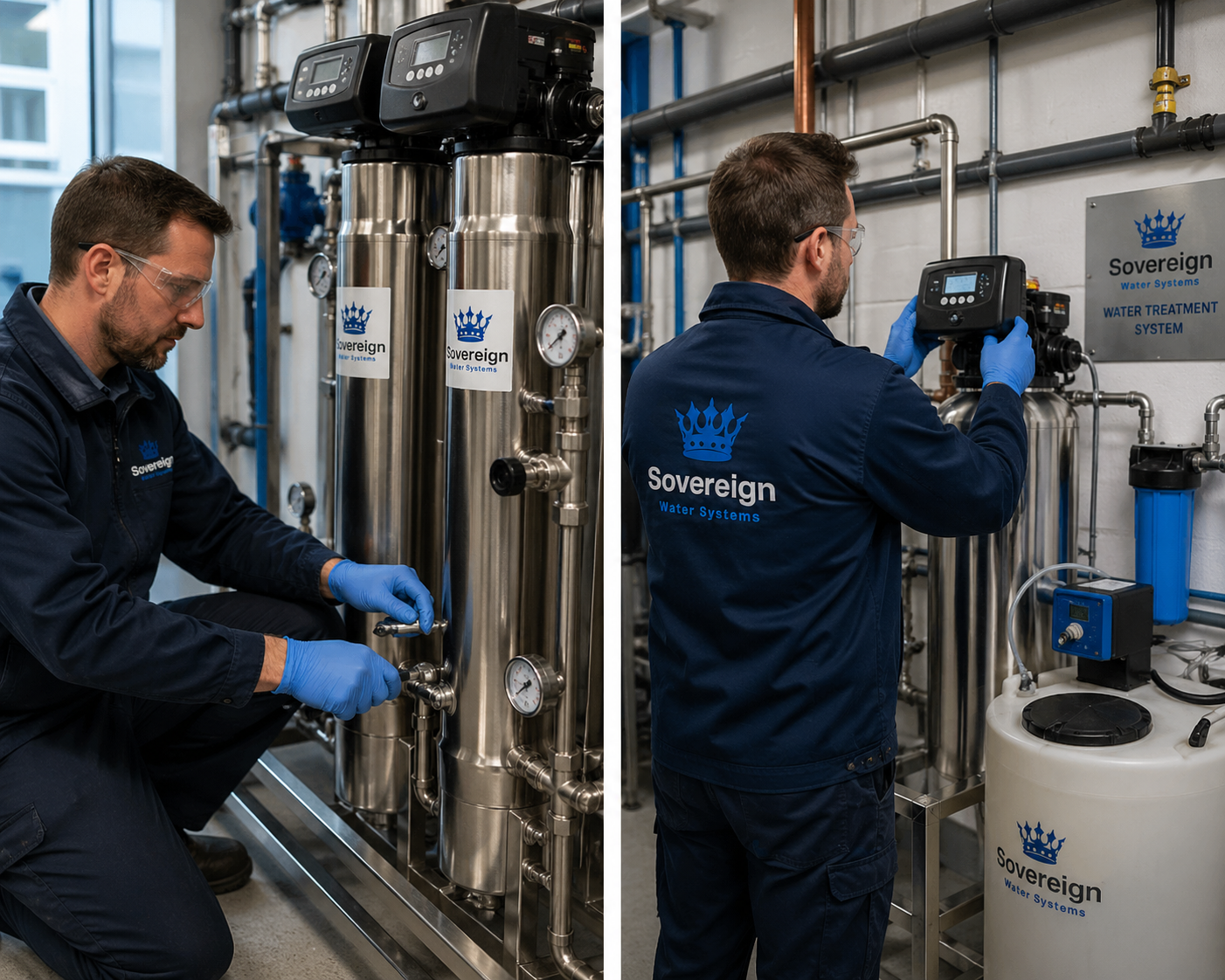

A water treatment maintenance schedule UAE facilities managers and building operators implement is the single most effective tool for protecting commercial water systems against the demanding combination of desalinated water supply, extreme ambient temperatures, and the world-class operational standards that Dubai and the Emirates’ commercial, hospitality, and healthcare sectors require. Without a structured programme, water treatment systems degrade in ways that are invisible until significant damage has occurred: filters exhaust their capacity, chemical dosing pumps lose calibration, storage tanks accumulate biofilm in the heat, and the conditions that create serious Legionella and microbiological risk develop undetected. At Sovereign Water, our Smart Maintenance programme delivers proactive, fully documented care that prevents these failures across UAE commercial sites.
The UAE’s water environment presents challenges that make disciplined maintenance scheduling particularly important. Desalinated water distributed across Dubai and the wider Emirates is naturally low in minerals but chemically aggressive without correct conditioning treatment. Ambient temperatures that regularly reach 45°C or above in summer make cold water storage temperature control a genuine operational challenge. The scale and sophistication of the UAE’s commercial real estate, five-star hospitality, healthcare, and mixed-use developments demands water system management that matches the standards of the built environment. This guide covers the full framework.
TL;DR
- A structured water treatment maintenance schedule reduces unplanned downtime by 30 to 50% and cuts maintenance costs by 18 to 25% compared to reactive approaches.
- Dubai and the wider Emirates’ extreme ambient temperatures make cold water storage control and Legionella monitoring significantly more demanding than in cooler climates.
- Chemical dosing systems for desalinated and high-TDS UAE water supplies require daily verification, monthly calibration, and quarterly overhauls to maintain consistent treatment.
- Annual system line disinfection and microbiological sampling are international best practice obligations for commercial buildings across the Emirates.
- Sovereign Water provides fully managed Smart Maintenance contracts for commercial water treatment systems across the UAE, including free site assessments.
In This Article
- Why a Water Treatment Maintenance Schedule Matters in the UAE
- What to Include in Your Commercial Schedule
- Frequency Breakdown: Daily to Annual Tasks
- Chemical Dosing: Maintenance, Calibration and Compliance
- Annual System Line Disinfection and Testing
- Legionella Monitoring, Sampling and International Best Practice
- Smart Maintenance vs Reactive Maintenance
- How to Build Your Water Treatment Maintenance Schedule
- How Sovereign Water’s Smart Maintenance Works in the UAE
- Frequently Asked Questions
Why a Water Treatment Maintenance Schedule Matters in the UAE
Commercial water treatment systems across Dubai and the Emirates operate under environmental and water quality conditions that amplify the consequences of poor maintenance. Desalinated water from the national supply network is low in natural minerals but without appropriate chemical conditioning it is corrosive to pipework, heat exchangers, and downstream equipment. In areas receiving blended or groundwater supplies, elevated TDS and hardness levels create scale risk that must be actively managed. Summer ambient temperatures regularly exceeding 45°C place extraordinary demands on cold water storage and distribution infrastructure, compressing the margin between safe cold water temperatures and the 20°C threshold at which Legionella bacteria can survive and multiply.
The UAE’s commercial sector operates to some of the most demanding built environment standards in the world. Five-star hotels, premium office towers, mixed-use developments, healthcare facilities, and food and beverage operations across Dubai and the wider Emirates are expected to deliver consistent, high-quality water to occupants and guests. A water treatment system that fails, or silently underperforms, does not just damage equipment: it creates compliance exposure, reputational risk, and in the worst cases, a genuine public health hazard. A properly structured and documented maintenance schedule is the operational foundation that prevents all of these outcomes.
Leading facilities management companies, hotel operators, and property developers across the UAE apply international best practice standards for water system maintenance, including the World Health Organisation’s Guidelines for Drinking Water Quality and the framework of the UK Health and Safety Executive’s Approved Code of Practice L8 and HSG274, recognised across the GCC as the benchmark for Legionella risk management. Dubai Municipality guidelines and the requirements of the Emirates Authority for Standardization and Metrology (ESMA) provide the local regulatory framework within which these international standards are applied. Sovereign Water supports clients across the UAE in implementing and maintaining these standards through our Smart Maintenance programme.

What to Include in Your Commercial Schedule
A comprehensive water treatment maintenance schedule for a UAE commercial building covers every system component from entry-point treatment to point-of-use equipment, each assigned a maintenance frequency matched to its role, its consequences of failure, and the specific water quality and climatic conditions of the site.
Key components that must feature in any UAE commercial schedule include scale inhibition and softening systems (critical for hard water supplies and RO membrane protection), filtration systems (cartridge and media replacements based on throughput and incoming water quality), reverse osmosis systems (membrane inspection, pre-filter changes, sanitisation, and performance monitoring against TDS targets), chemical dosing systems (reagent replenishment, pump calibration, and injection point integrity), UV disinfection units (annual lamp replacement and sleeve cleaning), cold and hot water storage tanks (inspection and cleaning at intervals appropriate to the high-temperature environment), and point-of-use dispensers, catering water equipment, and beverage systems (filter changes, hygiene checks, and sanitisation).
Water quality testing must be integrated at defined intervals covering TDS, hardness, pH, chlorine residual, and microbiological parameters. Annual system line disinfection and Legionella temperature monitoring are mandatory components of any commercially and legally compliant maintenance programme across the Emirates. Full documentation is not optional: it creates the compliance record that building owners, tenants, Dubai Municipality, and insurers require.
Frequency Breakdown: Daily to Annual Tasks
An effective water treatment maintenance schedule UAE commercial buildings can rely on follows the tiered frequency structure adopted by international facilities management organisations, organised across five time horizons: daily, weekly, monthly, quarterly, and annual.
Daily checks confirm operational status: softener and RO systems operating normally, filtration within pressure parameters, dosing pumps running with sufficient reagent, no leaks or alarms. In the UAE’s high-temperature environment, daily confirmation that cold water storage and distribution temperatures are within safe limits is recommended for all sites with a Legionella control programme.
Weekly inspections verify flow rates, bypass valve positions, connection integrity, and equipment surfaces. Digital monitoring data should be reviewed weekly to identify trends indicating an approaching service need.
Monthly tasks include water quality sampling (TDS, hardness, chlorine residual, pH), softener performance checks, filter pressure differential review, dosing pump calibration verification, Legionella sentinel outlet temperature monitoring, and consumables inventory management. Monthly TDS checks are particularly important across UAE sites to confirm RO systems are performing to specification, given the variability of desalinated supply quality and the sensitivity of downstream equipment to TDS exceedances.
Quarterly servicing covers chemical feed pump overhauls, valve exercising, RO membrane performance assessment, UV sleeve cleaning, Legionella microbiological sampling, storage tank internal inspection, and a full maintenance log review. In Dubai and the wider Emirates, quarterly storage tank inspection is strongly recommended given the rate of biofilm and sediment development under high ambient temperatures.
Annual overhauls include full system line disinfection and post-disinfection microbiological testing, RO membrane replacement assessment, softener resin testing, pressure vessel inspection, control panel calibration, UV lamp replacement, dosing programme review against current water chemistry, and a complete review of the Legionella risk assessment and water system schematic drawings.
Chemical Dosing: Maintenance, Calibration and Compliance
Chemical dosing is a critical and frequently under-maintained element of commercial water treatment across the UAE. Dubai’s desalinated water supply is chemically aggressive without appropriate conditioning: corrosion inhibitor dosing is essential for protecting copper, stainless steel, and galvanised distribution pipework. For sites receiving blended or higher-TDS supplies, scale inhibition is equally important for protecting RO membranes, heat exchangers, catering equipment, and beverage systems. A dosing pump under-delivering by even 20% will silently under-treat the system, with no visible indication until corrosion or scale becomes apparent in downstream equipment or water quality sampling results.
Common dosing applications across UAE commercial water systems include corrosion inhibitors for desalinated water conditioning and closed circuit heating and cooling treatment, scale inhibitors for high-TDS areas and RO pre-treatment, biocides for cooling tower water treatment and Legionella control, pH correction chemicals for RO pre-treatment and boiler feedwater conditioning, and sodium hypochlorite for storage tank and distribution system chlorination and disinfection.
The dosing maintenance schedule must include daily pump operation verification, weekly injection rate checks, monthly calibration against a known volume with injection point inspection, quarterly full pump head and diaphragm overhaul, and an annual dosing programme review against updated water chemistry data. All chemical handling on UAE sites must be governed by a current hazardous substances risk assessment covering appropriate controls, personal protective equipment, safe storage, secondary containment, and emergency response procedures, in line with UAE Ministry of Climate Change and Environment requirements and internationally recognised chemical safety standards. Sovereign Water includes chemical handling documentation review as a standard component of our UAE annual service visits.

Annual System Line Disinfection and Testing
Annual system line disinfection is a mandatory element of any internationally compliant water treatment maintenance programme across Dubai and the Emirates. It involves the chemical disinfection of all pipework, storage vessels, and distribution infrastructure to eliminate biofilm, remove accumulated sediment, and confirm the microbiological safety of the water system. In the UAE’s high-temperature environment, where biofilm development in storage tanks and dead legs is significantly accelerated compared to cooler climates, annual disinfection is a minimum rather than a maximum requirement.
The internationally recognised disinfection procedure, aligned with WHO guidance and WRAS standards widely referenced across the GCC, involves introducing sodium hypochlorite at 50mg/l free chlorine throughout the system, ensuring contact with all sections including all branches and dead legs for a minimum of one hour, followed by thorough flushing and post-disinfection microbiological testing before the system returns to service.
Additional disinfection beyond the annual programme is required following any positive Legionella result above the action threshold, significant remedial work on pipework or storage infrastructure, extended shutdown of four weeks or more, commissioning of new systems or system extensions, any unexplained deterioration in microbiological results, or evidence of sediment ingress or cross-contamination. Post-disinfection testing must be conducted by an accredited laboratory and all results retained as permanent site records. No system should be returned to service following disinfection without confirmed satisfactory post-disinfection microbiological test results.
Legionella Monitoring, Sampling and International Best Practice
Legionella risk management is among the most important water system responsibilities for commercial building operators across Dubai and the Emirates. The UAE’s extreme ambient temperatures create conditions that are considerably more challenging for Legionella control than in temperate markets. Outdoor temperatures regularly reaching 45°C or above during summer months place significant thermal load on cold water storage and distribution infrastructure. Any section of the system where insulation is inadequate, flow is restricted, or stagnation occurs in a dead leg or infrequently used outlet risks warming into the Legionella growth range of 20°C to 45°C, creating an active biological risk in a building occupied by staff, guests, or patients.
The framework applied by leading commercial building operators across Dubai and the UAE for Legionella risk management is the UK Health and Safety Executive’s Approved Code of Practice L8 and the supporting HSG274 technical guidance, supplemented by Dubai Municipality guidelines and the standards of the Emirates Authority for Standardization and Metrology (ESMA). This framework requires a current, site-specific Legionella risk assessment identifying all water systems, evaluating conditions that might support Legionella growth, and specifying appropriate control measures and monitoring frequencies. The risk assessment must be reviewed at least every two years, and immediately following any significant change to the water system, building use, or occupancy profile.
Temperature monitoring is the primary ongoing control measure. Hot water storage must reach and sustain a minimum of 60°C. Hot water distribution must deliver water at 50°C or above at sentinel outlets within one minute of running. Cold water storage and distribution must be maintained below 20°C throughout. In the UAE, achieving consistent cold water temperatures below 20°C requires particular attention to tank insulation, chilled water distribution systems, regular temperature verification, and the management of dead legs and low-use outlets. Temperature checks at sentinel outlets must be recorded monthly. A full system temperature survey must be conducted at least annually.
Legionella microbiological sampling from defined points (cold water storage tanks, hot water calorifiers, sentinel hot and cold outlets, spray outlets, and any higher-risk points identified by the risk assessment) should be conducted quarterly for medium-risk commercial buildings. Cooling towers and evaporative condensers, common across Dubai’s commercial estate, typically require monthly microbiological monitoring given their inherently higher Legionella risk. All samples must be tested by an accredited laboratory using ISO 11731 methodology. Results above 100 cfu/l require investigation and control regime review. Results above 1,000 cfu/l require immediate remedial action including system disinfection.
All Legionella monitoring records, temperature logs, sample results and laboratory certificates, disinfection records, maintenance logs, and the risk assessment must be retained for a minimum of five years and be available for review by building owners, tenants, Dubai Municipality, and other relevant authorities on request. A designated competent Responsible Person must be identified for each site with appropriate training and clear authority to ensure all control measures are implemented and maintained.
Smart Maintenance vs Reactive Maintenance
The cost and compliance case for preventive water treatment maintenance over a reactive approach is particularly compelling across Dubai and the Emirates, where the standards expected of commercial buildings, the complexity of large-scale water systems, and the reputational consequences of water quality or Legionella incidents are all amplified compared to many other markets.
Reactive maintenance creates costs that extend far beyond the immediate repair. A cooling tower biocide dosing pump that fails undetected allows biological growth to develop in conditions that are almost ideal for Legionella proliferation in Dubai’s summer temperatures. A corrosion inhibitor pump losing calibration allows aggressive desalinated water to attack pipework for weeks before the consequences become visible. A storage tank not inspected on schedule accumulates sediment and biofilm that no reactive intervention can efficiently address once established. The cost of documented preventive maintenance is consistently lower than the combined cost of reactive repairs, equipment replacement, and compliance exposure.
Smart Maintenance incorporates real-time performance monitoring to optimise the timing and scope of preventive interventions. A filter approaching capacity, a dosing pump consuming reagent at an unexpected rate, a sentinel outlet temperature trending upward towards the action threshold: all of these generate early alerts that allow targeted intervention before failure. This approach protects systems more effectively than calendar-based preventive maintenance alone, whilst avoiding unnecessary service visits where systems are performing within specification.
How to Build Your Water Treatment Maintenance Schedule
Building an effective water treatment maintenance schedule for a UAE commercial site begins with a professional water quality assessment and system survey. This establishes baseline chemistry parameters (TDS, hardness, pH, chlorine residual, and microbiological indicators where relevant), confirms whether existing treatment systems are correctly specified for the incoming water supply, identifies any gaps in chemical dosing or monitoring programmes, and establishes whether a current Legionella risk assessment is in place for the site.
The schedule is then structured around the tiered frequency model described in this guide, with every task assigned a responsible party, a completion timeframe, and a documentation requirement. Escalation criteria must be clearly defined: the conditions (temperature exceedance, out-of-specification water quality result, positive Legionella sample, dosing pump fault) that trigger immediate intervention rather than waiting for the next scheduled visit.
For multi-site operators across the UAE (commercial property portfolios, hotel groups, healthcare networks, food and beverage chains across Dubai and the wider Emirates), a standardised maintenance schedule across all locations delivers compliance consistency and meaningful cost efficiency. Sovereign Water manages portfolio-wide water treatment maintenance programmes across the UAE under single service agreements, with consistent technical standards and a single point of contact. Contact our team to discuss your UAE requirements.
How Sovereign Water’s Smart Maintenance Works in the UAE
Sovereign Water has delivered commercial water treatment solutions across the UAE and the wider GCC for many years, with deep familiarity with the specific water quality challenges, regulatory environment, and operational expectations of Dubai and the Emirates’ commercial market. Our Smart Maintenance programme provides fully managed water treatment maintenance for UAE clients, removing the burden of schedule management, consumable procurement, chemical compliance, Legionella monitoring, and documentation from facilities teams.
Every Smart Maintenance engagement in the UAE begins with a free site assessment: a comprehensive survey of existing water treatment systems, incoming water quality testing, review of maintenance records and risk assessments, and identification of any compliance or performance gaps. From this assessment, we build a bespoke maintenance schedule integrating equipment servicing, chemical dosing calibration and compliance documentation, Legionella temperature monitoring and sampling coordination, annual line disinfection and post-disinfection testing, water quality reporting, and responsive technical support into a single coordinated programme.
The practical benefit for UAE facilities managers is complete clarity and confidence: a professionally managed, fully documented water treatment programme that meets international standards, protects building infrastructure and occupant health, and provides a complete audit trail at all times. To find out how our Smart Maintenance programme can be structured for your UAE site or portfolio, contact our team today.
Frequently Asked Questions
How often should commercial water treatment systems be serviced in the UAE?
Most commercial systems across Dubai and the Emirates require daily operational checks, monthly water quality testing and Legionella sentinel temperature monitoring, quarterly equipment servicing and microbiological sampling, and a full annual overhaul including system line disinfection. The UAE’s extreme ambient temperatures make cold water temperature control, storage tank inspection, and Legionella monitoring more demanding components of the programme than in cooler climates.
Why is Legionella risk particularly significant in Dubai and the UAE?
Ambient temperatures regularly exceeding 45°C in summer create thermal conditions that make it significantly harder to maintain cold water storage and distribution below the 20°C threshold for Legionella control. Dead legs, inadequately insulated pipework, and infrequently used outlets are high-risk in this climate. Cooling towers, widespread across Dubai’s commercial estate, require monthly microbiological monitoring due to their elevated inherent Legionella risk.
What chemical dosing is required for desalinated water systems in the UAE?
Desalinated water is naturally low in minerals but chemically corrosive without appropriate conditioning. Corrosion inhibitor dosing is essential for protecting pipework and equipment. Scale inhibition is required where blended or higher-TDS water is present, and for RO pre-treatment. Biocide dosing for cooling tower Legionella control, pH correction for boiler feedwater, and sodium hypochlorite for tank chlorination are also common applications across UAE commercial sites.
What standards apply to water treatment maintenance in the UAE?
Leading operators across Dubai and the Emirates apply the WHO Guidelines for Drinking Water Quality, the UK HSE Approved Code of Practice L8 and HSG274 for Legionella control, and WRAS guidance for disinfection procedures. Dubai Municipality guidelines and ESMA requirements provide the local regulatory framework. Sovereign Water helps clients implement and document compliance with these standards across their UAE operations.
How does Sovereign Water support water treatment compliance across the UAE?
Sovereign Water provides fully managed Smart Maintenance contracts across the UAE covering all scheduled servicing, chemical dosing management and compliance documentation, Legionella monitoring and sampling coordination, annual line disinfection and post-disinfection testing, and complete water treatment records. We manage the entire programme on the client’s behalf with a single point of contact across single or multiple Emirates sites.
Ready to Put a Proper Maintenance Schedule in Place Across Your UAE Sites?
Sovereign Water builds and manages bespoke water treatment maintenance schedules for commercial businesses across Dubai and the Emirates. From free site assessments to fully managed Smart Maintenance contracts covering chemical dosing, Legionella monitoring, annual disinfection, and compliance documentation, we take the complexity out of water system management across the UAE.

