Hydrotap UAE: Why Instant Boiling Water Units Matter in the Gulf
The instant boiling water tap, commonly referred to as a hydrotap, has moved well beyond its origins as a premium office amenity. Across the UAE, commercial facilities ranging from corporate headquarters in Dubai's DIFC to hotel kitchens in Abu Dhabi and healthcare campuses in Sharjah are specifying these units as standard infrastructure. The reasons are both operational and regulatory, and understanding them is essential before selecting a supplier or installer.
At its core, a hydrotap delivers filtered boiling, chilled, and in many configurations sparkling water on demand, eliminating the need for kettles, bottled water coolers, and the associated labour and plastic waste. For a facility manager overseeing a 200-person office, the efficiency argument alone is compelling. Staff no longer queue at a kettle, hot beverages are prepared in seconds, and the unit operates continuously without manual intervention. For hospitality venues, the ability to serve still, sparkling, and boiling water from a single countertop fixture elevates the guest experience while reducing back-of-house complexity.
However, the UAE presents a set of water quality challenges that make product selection considerably more nuanced than it would be in, say, the United Kingdom or Germany. Municipal water in the UAE is predominantly desalinated, either through multi-stage flash or reverse osmosis processes, and is then blended and distributed through an ageing network of pipes and rooftop storage tanks. This journey introduces several variables that directly affect the performance and longevity of any hydrotap unit.
Elevated total dissolved solids (TDS) are common, even in desalinated supplies, once water has passed through distribution infrastructure. Hardness levels vary significantly by emirate and by building, with calcium and magnesium scaling posing a persistent threat to heating elements and internal components. Sediment from storage tanks, particularly in older buildings, can compromise filters and reduce flow rates. Residual chlorine, added as a disinfectant, affects taste and can degrade certain filter media over time.
These challenges are not merely operational inconveniences. They sit within a clear regulatory framework. The Abu Dhabi Water Quality Regulations 2025, issued by the Department of Energy, require drinking water to contain zero E. coli, zero total coliforms and zero intestinal enterococci per 100 ml, with turbidity no higher than 4 NTU (and ideally below 1 NTU to support disinfection). These regulations bind the licensed water companies rather than individual buildings, but they set the benchmark that building owners and facility managers are measured against, so any water dispensing equipment on their premises should help maintain that standard, not undermine it.
Selecting a hydrotap for a UAE commercial site therefore requires more than comparing aesthetics or price points. It demands a clear understanding of how each unit handles the specific inlet water conditions present in the Gulf, what upstream pre-treatment may be required, and how the manufacturer's filtration technology aligns with local compliance expectations. The following sections address exactly that, comparing two of the most specified units in the UAE commercial market: the ZIP HydroTap G5 and the BRITA Extra C-Tap.
Understanding the Two Contenders: ZIP HydroTap G5 and BRITA Extra C-Tap
ZIP HydroTap G5: Design-Led Performance
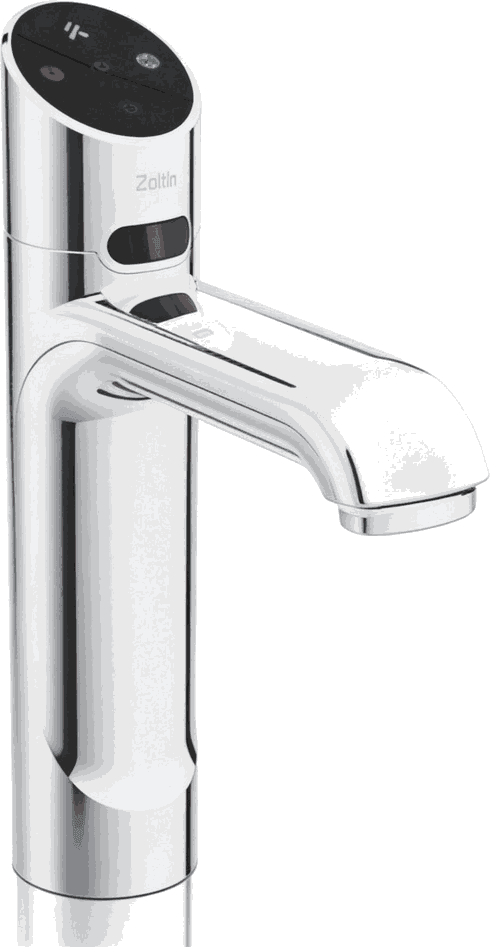
The ZIP HydroTap G5 is the current flagship from ZIP Water, an Australian brand with a well-established presence in the UK, Middle East, and Asia-Pacific commercial markets. The G5 is available in multiple dispensing configurations, including boiling and chilled, and boiling, chilled and sparkling, allowing specifiers to match the unit to the precise requirements of the installation. This flexibility makes it suitable for everything from a compact executive pantry to a high-volume hospitality servery.
From a design perspective, the G5 is one of the more considered products in its category. It is available in a range of finishes and tap styles, with tap head designs that complement contemporary commercial interiors. The unit's compact under-counter boiler and chiller module is engineered to fit within standard joinery, a practical advantage in refurbishment projects where under-counter space is limited.
The G5 is set up through ZIP's on-unit command centre, which controls temperatures, energy-saving modes and filter alerts, and sparkling models include sensors that warn when the CO2 cylinder or filter needs changing. For facility managers, these alerts reduce the risk of filter overruns and unplanned service calls. A Touch-Free Wave option lets users dispense without touching the tap.
BRITA Extra C-Tap: European Engineering and Hygiene Focus
The BRITA Extra C-Tap represents BRITA's commercial hydrotap offering, developed from the company's deep filtration heritage. BRITA, headquartered in Germany, has built its reputation over decades on the science of water filtration, and the C-Tap reflects that institutional knowledge in its engineering approach.
The C-Tap is a brushed stainless-steel designer tap with a glass touch panel. It dispenses up to five water types: unchilled or chilled still, semi-sparkling and sparkling, with optional instant hot water, and BRITA recommends it for 20 to 100 people. Its most distinctive technical feature is ThermalGate hygiene technology, which regularly heats the tap to defend against germs and protects the outlet against external contamination such as touching or sneezing. This is a particularly relevant credential in the UAE, where ambient temperatures and warm building infrastructure can accelerate microbial growth in stagnant water lines.
The C-Tap uses two BRITA filters. A PURITY C filter on the hot water side reduces carbonate hardness to protect the boiler from scale, while a CLARITY Protect hollow fibre membrane filter on the cold side reduces 99.999% of bacteria, 99.95% of cysts and over 99% of PFAS, as well as microplastics. Filters are sized to the site's water and usage, so an inlet water test before installation is a sensible step in markets like the UAE where inlet water quality varies considerably.
Side-by-Side Specification Overview
The table below provides a structured comparison across the key specification categories that matter most to commercial buyers and facility managers in the UAE market.
-
Dispensing Modes: ZIP G5 offers boiling, chilled and sparkling. BRITA C-Tap offers unchilled and chilled still, semi-sparkling and sparkling, with optional instant hot water.
-
Finish Options: ZIP G5 is available in several finishes and tap styles. BRITA C-Tap is a brushed stainless-steel tap with a glass touch panel.
-
Hygiene Technology: ZIP G5 uses a 0.2 micron MicroPurity filter, with a Touch-Free Wave option and an UltraCare system for healthcare. BRITA C-Tap uses ThermalGate, which regularly heats the tap, as standard.
-
Filtration System: ZIP G5 uses a 0.2 micron MicroPurity filter. BRITA C-Tap uses a PURITY C filter on the hot side and a CLARITY Protect membrane filter on the cold side.
-
Controls and Alerts: ZIP G5 is set up through its command centre, with filter and CO2 alerts on sparkling models. BRITA C-Tap has a glass touch panel, leakage detection and an emergency shut-off.
-
Under-Counter Footprint: Both units are designed for standard under-counter joinery.
-
Brand Origin: ZIP is an Australian brand. BRITA is a German brand.
-
Pre-Treatment Requirements: Both units benefit from upstream sediment pre-filtration in UAE conditions, and a site water test should confirm what is needed.
This overview establishes the foundation for the detailed section-by-section comparison that follows, beginning with the area of greatest consequence for UAE installations: filtration and water quality performance.
Filtration and Water Quality Performance in UAE Conditions
The Inlet Water Challenge in the Gulf
Any honest assessment of hydrotap performance in the UAE must begin with the inlet water. Unlike a European installation where mains water arrives at relatively consistent quality from a well-maintained municipal network, a UAE commercial site may receive water that has passed through desalination, long-distance distribution, elevated storage tanks, and building pipework of varying age and condition. Each stage introduces potential quality variables.
Sediment is a common finding in UAE building water samples, particularly in older commercial properties where rooftop tanks have not been recently cleaned or replaced. Even fine particulate matter at levels invisible to the naked eye can accelerate filter media degradation and reduce the effective service life of a hydrotap's internal components. Chlorine, dosed into the distribution network as a disinfectant, is present at varying concentrations and contributes to the flat, chemical taste that makes unfiltered tap water unpalatable in many UAE locations. Hardness, driven by calcium and magnesium ions, creates scaling on heating elements and internal surfaces, reducing thermal efficiency and ultimately shortening equipment lifespan.
Elevated TDS is perhaps the most persistent challenge. Desalinated water is inherently low in TDS at the point of production, but by the time it reaches a commercial tap, blending with groundwater sources and passage through infrastructure can push TDS readings to levels that affect both taste and equipment performance. For a hydrotap unit operating continuously in a high-use commercial environment, these conditions are not edge cases. They are the daily operating reality.
ZIP HydroTap G5 Filtration Approach
The ZIP G5 uses a 0.2 micron MicroPurity filter, which ZIP states is certified to reduce up to 99.9% of bacteria, including Cryptosporidium and Giardia, as well as lead and microplastics. The filter is designed for easy replacement, and the unit alerts users when a change is due.
ZIP's filter is not a dedicated scale treatment, so it is not built to deal with the hardness found in some UAE buildings. In practice, most competent installers will specify an upstream pre-filter, typically a sediment cartridge and a scale inhibitor or water softener, before the G5 unit, to protect the heating element from premature scaling.
BRITA Extra C-Tap Filtration Approach
BRITA splits the job between two filters. The PURITY C filter on the hot water side reduces carbonate hardness, which directly protects the boiler from scale. The CLARITY Protect hollow fibre membrane on the cold side reduces 99.999% of bacteria, 99.95% of cysts and over 99% of PFAS, as well as microplastics.
A good installer will test the inlet water for TDS, hardness, pH and chlorine before fitting either unit, then size the filters and any pre-treatment to the site. This is not a sales formality. It directly determines whether the installed unit will perform to specification.
Because the C-Tap includes a dedicated hardness filter as standard, it may need less separate scale treatment than the ZIP G5 on moderately hard supplies, although very hard water will still need upstream treatment for either unit.
Section Assessment: Filtration and Water Quality
Both units require competent installation and appropriate pre-treatment to perform reliably in UAE conditions. Neither should be connected directly to an unfiltered building supply without upstream sediment protection at a minimum. Both units filter finely for microbiological safety. The main difference is scale: BRITA adds a dedicated hardness filter on the hot side as standard, which suits UAE sites where hardness varies from building to building.
The ZIP G5 remains a strong performer in sites where upstream pre-treatment has been properly specified and installed, and its filter alerts add genuine operational value. On filtration as a standalone assessment, BRITA's two-filter set-up gives it a slight edge for hard or variable UAE supplies.
Hygiene, Safety and Compliance for UAE Commercial Environments
For commercial facilities operating in the UAE, microbiological water quality is not a secondary consideration. The combination of high ambient temperatures, long pipe runs in large commercial buildings, and the characteristics of municipal supply infrastructure means that hygiene at the point of dispense carries genuine operational and regulatory significance. Both ZIP and BRITA have engineered hygiene features into their respective systems, but the approaches differ in meaningful ways.
BRITA ThermalGate Technology
BRITA's ThermalGate mechanism is one of the more technically distinctive hygiene features available in the commercial hydrotap category. BRITA states that it regularly heats the tap to defend against germs and protects the outlet against external contamination, such as touching or sneezing. This targets the dispense point itself, where contamination from hands and the surrounding air is most likely.
In the context of UAE regulatory expectations, this matters. The UAE's federal technical regulation for drinking water, Cabinet Resolution No. 22 of 2022, adopts the GSO 149:2021 Gulf standard, which requires zero E. coli and zero total coliforms. High ambient temperatures accelerate microbial growth within water systems, and any stagnation point within a dispense unit represents a potential risk. ThermalGate helps reduce the conditions in which bacteria can build up at the tap outlet.
For facility managers responsible for demonstrating due diligence around drinking water safety, particularly in healthcare, hospitality, or food service environments, ThermalGate provides a documentable, automated hygiene intervention that does not depend on staff behaviour or manual cleaning schedules.
ZIP HydroTap G5 Hygiene Features
The ZIP HydroTap G5 addresses contamination risk through a sealed internal water pathway and its 0.2 micron MicroPurity filter, which ZIP states reduces up to 99.9% of bacteria before water reaches the dispense point. For healthcare settings, ZIP offers an UltraCare system with four barriers against bacteria, and the Touch-Free Wave option lets users dispense without touching the tap.
The G5's sealed system architecture reduces the risk of external contamination during normal operation, and ZIP's filter replacement schedule is designed to maintain consistent filtration performance between service intervals. In high-use commercial settings such as corporate offices or hotel lobbies, where the unit may dispense hundreds of litres daily, the integrity of the sealed pathway is a practical advantage.
However, ZIP does not describe an equivalent to ThermalGate's regular heating of the tap outlet, so outlet cleaning remains part of the routine service.
Section Assessment
Both systems demonstrate a serious commitment to hygiene engineering. For UAE commercial environments where microbiological compliance is subject to regulatory scrutiny and where ambient conditions accelerate biological risk, BRITA's ThermalGate mechanism provides a demonstrable hygiene advantage. The regular heating of the tap outlet is a targeted, automated intervention that supports the microbiological quality requirements relevant to UAE facility operators. Facility managers seeking to document and demonstrate hygiene compliance will find BRITA's approach particularly well suited to the demands of the regional operating environment.
Design, Finishes, Controls and Footprint
For premium commercial fit-outs across the UAE, whether in Grade A office towers, five-star hotel suites, or high-end co-working facilities, the visible specification of a drinking water system carries genuine design weight. A hydrotap installed in a client-facing kitchen or executive pantry is part of the interior scheme, not simply a utility fixture. On this basis, the design credentials of ZIP and BRITA diverge significantly.
ZIP HydroTap G5: Design Leadership
The ZIP HydroTap G5 is, by any reasonable measure, the more design-considered product in this comparison. ZIP offers the G5 across a range of tap body styles and finishes, giving specifiers genuine flexibility to match the unit to the surrounding interior language and the premium material preferences common in UAE commercial interiors.
The G5's controls are integrated cleanly into the tap body, with a child-safety lock on the boiling function and a cool-touch tap. This contributes to a minimal aesthetic that holds up well in high-specification environments, and the controls are intuitive enough to need little staff training.
The under-counter unit is compact by category standards, with dimensions that allow installation within standard base cabinet configurations. This is a practical consideration in UAE commercial fit-outs where under-counter space is often shared with other services, and where the mechanical room or service void may be constrained by the building's existing infrastructure.
BRITA Extra C-Tap: Functional Rather Than Decorative
The BRITA Extra C-Tap is a competent and well-engineered product, but its design positioning is more utilitarian than the ZIP G5. Finish options are more limited, with the tap offered in brushed stainless steel, which may present a specification challenge in environments where the interior design brief calls for a specific material palette or finish tone.
The control interface on the BRITA unit is a glass touch panel, functional and straightforward, with clearly labelled dispense options. It performs its operational role reliably, but it offers fewer styling choices than the ZIP G5. For back-of-house or staff welfare installations where aesthetics are secondary to performance, this is an entirely acceptable trade-off. For client-facing or design-led environments, it represents a limitation.
The BRITA under-counter footprint is broadly comparable to the ZIP unit, and installation within standard cabinetry is achievable without significant modification in most cases.
Section Assessment
ZIP leads this category clearly. The G5's finish range and tap body variety make it the preferred specification for design-conscious UAE projects. For facility managers and interior designers working on premium office, hospitality, or retail fit-outs, the ZIP HydroTap G5 offers the flexibility and aesthetic quality to meet demanding briefs without compromise. BRITA remains a strong performer in environments where design is not the primary selection criterion.
Installation, Maintenance and Long-Term Ownership in the UAE
Selecting a commercial hydrotap is a medium to long-term infrastructure decision. The purchase price represents only a portion of the total cost of ownership, and in the UAE, where service infrastructure, water quality conditions, and building management expectations differ from European markets, the practical realities of installation and ongoing maintenance deserve careful consideration.
Installation Requirements
Both the ZIP HydroTap G5 and the BRITA Extra C-Tap require a cold water mains connection, a dedicated power supply, and adequate ventilation around the under-counter unit to manage heat dissipation from the boiling and chilling mechanisms. In UAE commercial buildings, particularly those with centralised building management systems, coordinating these requirements with the base building's mechanical and electrical infrastructure is a standard part of the commissioning process.
A qualified UAE-based installer is not simply a preference but a practical necessity. Local knowledge of UAE water supply pressures, which can vary considerably across emirates and building types, is essential for correct pressure regulation and filter sizing. An installer unfamiliar with regional supply characteristics risks incorrect commissioning, which can affect product performance. Sovereign Water recommends engaging installers with documented experience in UAE commercial water system installations for both product lines.
ZIP's G5 installation is well documented, with a structured commissioning process that includes flow rate testing and filter priming. BRITA's installation process is similarly systematic, and the company's technical documentation is thorough. Neither unit presents unusual installation complexity for a competent commercial plumber with relevant experience.
Ongoing Maintenance and Filter Intervals
UAE mains water is treated to potable standards, but its mineral content varies by source and building, and water stored in rooftop tanks can pick up sediment. This has direct implications for filter longevity and descaling frequency. Both ZIP and BRITA supply filters rated for specific volumes, and in high-use UAE commercial environments, actual filter life may be shorter than the headline specification suggests.
BRITA's filter technology, drawing on the company's extensive background in filtration chemistry, is well regarded for consistent performance across variable input water quality. The BRITA Extra C-Tap's maintenance schedule is straightforward, with clear service intervals and a filter replacement process that does not require specialist tools or extended downtime. The unit's build quality supports longevity in demanding environments, and the relative simplicity of its mechanical architecture reduces the number of components that require periodic attention.
ZIP's G5 maintenance schedule is similarly structured, with filter replacement, descaling, and periodic sanitisation forming the core of the service programme. Check that your installer can cover every emirate where you have sites.
Section Assessment
For long-term ownership in UAE commercial environments, BRITA's robust build quality and straightforward maintenance schedule represent a practical advantage. The combination of reliable filtration performance across variable water quality conditions, a simple service programme, and a mechanically durable product architecture supports consistent operation over a multi-year ownership period. Facility managers prioritising low total cost of ownership and predictable maintenance demands will find the BRITA Extra C-Tap a dependable long-term asset in high-use commercial settings.
UAE Application Guide: Which Unit Suits Your Facility?
Selecting the right hydrotap for a UAE facility is not simply a matter of brand preference. The decision should be driven by the operational environment, the volume of daily usage, the aesthetic brief, and the long-term servicing model available in-country. Both the ZIP HydroTap G5 and the BRITA Extra C-Tap are credible, well-engineered products, but they are optimised for different applications. Understanding those differences allows facility managers and specifiers to make a confident, informed choice.
ZIP HydroTap G5: Best Suited For Design-Led and Premium Environments
The ZIP HydroTap G5 is the stronger recommendation for projects where the drinking water point forms part of a considered interior specification. Its relevance is clearest in the following settings:
-
Design-led corporate offices: The G5 is available in multiple finish options and faucet profiles, allowing it to integrate cleanly with premium joinery and kitchen fitouts. For UAE free zone offices and headquarters environments where the pantry or breakout space is a statement, this matters.
-
Premium hospitality venues: Hotels, executive lounges, and high-end food and beverage operations benefit from the G5's compact under-counter footprint and its ability to deliver boiling, chilled, and sparkling water from a single tap point.
-
Co-working and serviced office spaces: Where multiple tenants share facilities and the operator wants a consistent, low-maintenance hydration solution, the G5's filter and CO2 alerts add genuine operational value.
BRITA Extra C-Tap: Best Suited For High-Throughput and Regulated Environments
The BRITA Extra C-Tap is the more appropriate specification where volume, hygiene assurance, and filtration robustness take priority over aesthetics. Key applications include:
-
Commercial kitchens and catering operations: High daily water draw volumes demand a unit built for continuous throughput. The C-Tap's filtration architecture is designed to maintain consistent output quality under sustained demand.
-
Healthcare facilities: Hospitals, clinics, and medical centres need documented filtration performance and traceable hygiene credentials. BRITA's published filter performance and ThermalGate support this, and ZIP's UltraCare system is also designed for healthcare.
-
Education campuses: Schools and universities with large student populations need reliable, cost-effective hydration infrastructure. The C-Tap's longevity and straightforward filter replacement schedule make it a practical choice at scale.
-
Sites where filtration longevity is the primary brief: Where the client's overriding concern is reducing scale, sediment, and chlorine taste in UAE desalinated water over an extended service interval, the C-Tap's dedicated hardness filter is a meaningful advantage.
Product Card Summary
ZIP HydroTap G5: Boiling, chilled, and sparkling output. Multiple faucet and finish options. Filter and CO2 alerts. Compact under-counter installation. Best for: premium offices, hospitality, co-working.
BRITA Extra C-Tap: Unchilled and chilled still, semi-sparkling and sparkling, with optional instant hot water. ThermalGate hygiene and two-filter protection. Recommended for 20 to 100 people. Best for: commercial kitchens, healthcare, education, high-throughput sites.
Where Sovereign Water's RoyalFlow Series Fits
For clients who find that neither the G5 nor the C-Tap fully addresses their specification, Sovereign Water's own RoyalFlow Series offers a UAE-specified alternative worth considering. Available in seven faucet designs across Bright Chrome and Matt Black finishes, and engineered with S1 and C1 smart controls, the RoyalFlow Series delivers instant boiling, sparkling, and chilled water in a format developed with the Gulf region's water quality profile in mind. For projects requiring bespoke configuration, local technical support, or a solution specified from the ground up for UAE desalinated supply, the RoyalFlow Series warrants direct discussion with the Sovereign Water team.
Frequently Asked Questions: Hydrotap UAE Installation and Compliance
Facility managers and installers working in the UAE frequently raise the same set of practical questions when specifying hydrotap systems. The answers below reflect the realities of the UAE's water supply infrastructure, regulatory environment, and servicing landscape.
Do ZIP HydroTap and BRITA Extra C-Tap Units Meet UAE Water Quality Regulations?
Both products carry internationally recognised certifications, including NSF and relevant European standards, which are widely accepted as benchmarks by UAE authorities and consultants. However, the UAE does not operate a single unified product approval register equivalent to, for example, WRAS in the United Kingdom. Facility managers working on projects subject to Dubai Municipality, Abu Dhabi Department of Energy, or specific free zone authority oversight should confirm the applicable local standard with their consultant or authority having jurisdiction before finalising specification. Neither product should be assumed to carry automatic regulatory clearance for every UAE application without that verification step.
Is Upstream Treatment Always Required in the UAE?
This is one of the most important questions for any UAE hydrotap installation, and the honest answer is: in most cases, yes. The UAE's municipal water supply is predominantly desalinated, which means it arrives at the point of use with a different mineral and chemical profile than groundwater-fed European supplies. Desalinated water can carry elevated chlorine levels used during distribution, variable pH, and in older building infrastructure, potential contamination from pipework. Both the ZIP G5 and the BRITA C-Tap incorporate filtration, but neither is designed to function as a standalone treatment solution for heavily degraded or non-potable incoming supply. A pre-filtration or upstream treatment stage, whether a sediment filter, activated carbon stage, or a more comprehensive system, is strongly advisable in most UAE commercial installations. Sovereign Water specifies the right treatment for your supply before any hydrotap is installed.
What Certifications Should I Look For?
For UAE commercial installations, the following certifications carry the most weight with consultants and authorities:
-
NSF/ANSI 42 and 53: Cover aesthetic and health-related contaminant reduction respectively. Widely referenced in Gulf region specifications.
-
NSF/ANSI 372: Confirms lead-free compliance, which is increasingly required in healthcare and education projects.
-
ISO 9001: Confirms the manufacturer's quality management system, relevant for procurement teams requiring documented supply chain assurance.
-
WRAS (UK): While a UK standard, WRAS approval is frequently cited in UAE specifications prepared by British or internationally trained consultants.
Always request the current, valid certification documentation from the supplier and confirm it covers the specific model being installed, not simply the product family.
How Often Do Filters Need Changing in UAE Conditions?
Filter life in the UAE is typically shorter than the manufacturer's stated interval, which is usually calculated against a European or North American water quality baseline. The combination of higher chlorine levels, variable turbidity, and the mineral profile of desalinated water means filters work harder. As a practical guide, facilities should plan for earlier filter changes than the stated interval until actual site consumption data is available. High-throughput sites, such as commercial kitchens or large office canteens, should establish a quarterly review cycle regardless of the indicator reading. Both ZIP and BRITA provide filter life monitoring, but local conditions mean those indicators should be treated as a ceiling, not a target.
Can Both Units Handle the UAE's Desalinated Water Supply?
Both units are compatible with desalinated municipal supply and will function correctly when installed with appropriate upstream treatment. Neither unit is damaged by desalinated water per se, but the filtration demands are higher than in regions with naturally mineralised groundwater. The BRITA Extra C-Tap's dedicated hardness filter is an advantage where the supply is hard, and the ZIP G5 performs reliably with a correctly specified pre-filter stage in place.
Who Installs and Services These Units in the UAE?
Both ZIP and BRITA operate through regional distributor and installer networks in the UAE. Facility managers should confirm that any installer is authorised by the brand, carries the relevant UAE trade licence for MEP or fit-out works, and can provide a documented service agreement covering filter replacement, annual maintenance, and emergency callout. Sovereign Water supports clients through the specification and procurement process and can advise on appropriate local installation and servicing arrangements as part of a site assessment consultation.
Neutral Verdict
Neither the ZIP HydroTap G5 nor the BRITA Extra C-Tap is the universally superior product. The right choice is the one that matches the specific demands of the facility, the incoming water quality, the daily usage volume, and the servicing model available. For projects where those variables are complex or where a UAE-specified solution is preferred, Sovereign Water's RoyalFlow Series and technical consultation service offer a practical alternative route to specification.
To discuss your facility's requirements or to request a quote, contact the Sovereign Water team directly.
Frequently Asked Questions
What is the main difference between the ZIP HydroTap G5 and the BRITA Extra C-Tap for UAE installations?
The ZIP HydroTap G5 is primarily optimised for design-led environments where aesthetics, finish choice, and compact footprint are priorities. It suits premium offices, hospitality venues, and co-working spaces. The BRITA Extra C-Tap is engineered for high-throughput, hygiene-critical environments such as commercial kitchens, healthcare facilities, and education campuses, where filtration robustness and longevity are the primary brief. In UAE conditions, both units benefit from upstream pre-filtration given the characteristics of the desalinated municipal supply.
Does Sovereign Water install and service hydrotap systems in the UAE?
Sovereign Water provides specification consultation, product guidance, and site assessment services to support facility managers and installers working on UAE projects. The team can advise on appropriate product selection, upstream treatment requirements, and local installation and servicing arrangements. For clients seeking a UAE-specified solution developed with the Gulf region's water quality profile in mind, Sovereign Water's own RoyalFlow Series is available as an alternative to international brand options. Contact the team directly to discuss your project requirements.
Is a water quality assessment necessary before installing a hydrotap in a UAE commercial facility?
A site water quality assessment is strongly recommended before specifying any hydrotap system in the UAE. The country's desalinated municipal water supply has a different chemical and mineral profile to European or North American supplies, and older building infrastructure can introduce additional variables including sediment and elevated chlorine levels. An assessment allows the specifier to confirm whether upstream treatment is required, select the appropriate filtration specification, and set realistic filter replacement intervals. Installing a hydrotap without this step risks underperformance, shortened filter life, and potential non-compliance with the facility's water quality obligations.
Need Support With This?
Contact Sovereign Water to discuss how we can help. Get in touch.
Sources
- BRITA, Extra C-Tap product page: https://www.brita.co.uk/water-dispensers/products/extra-c-tap
- ZIP Water, HydroTap technology: https://www.zipwater.co.uk/hydrotap/technology
- ZIP Water, HydroTap safety: https://www.zipwater.co.uk/hydrotap/safety
- Department of Energy Abu Dhabi, Water Quality Regulations 2025: https://www.doe.gov.ae
- UAE Cabinet Resolution No. 22 of 2022 on the technical regulation for drinking water: https://uaelegislation.gov.ae/en/legislations/1758
Products mentioned in this article
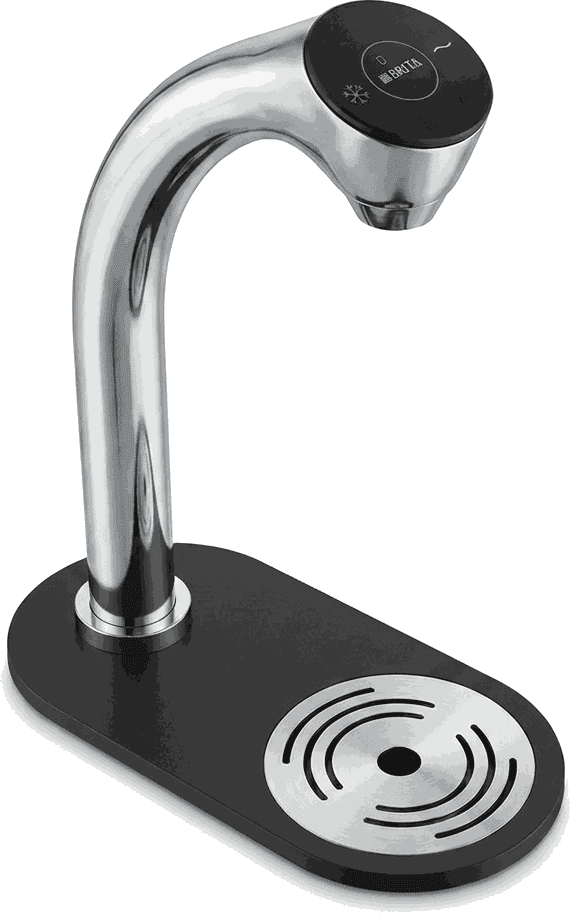
BRITA's signature undercounter dispenser delivers up to five water types from a single brushed stainless steel tap…
View product →