
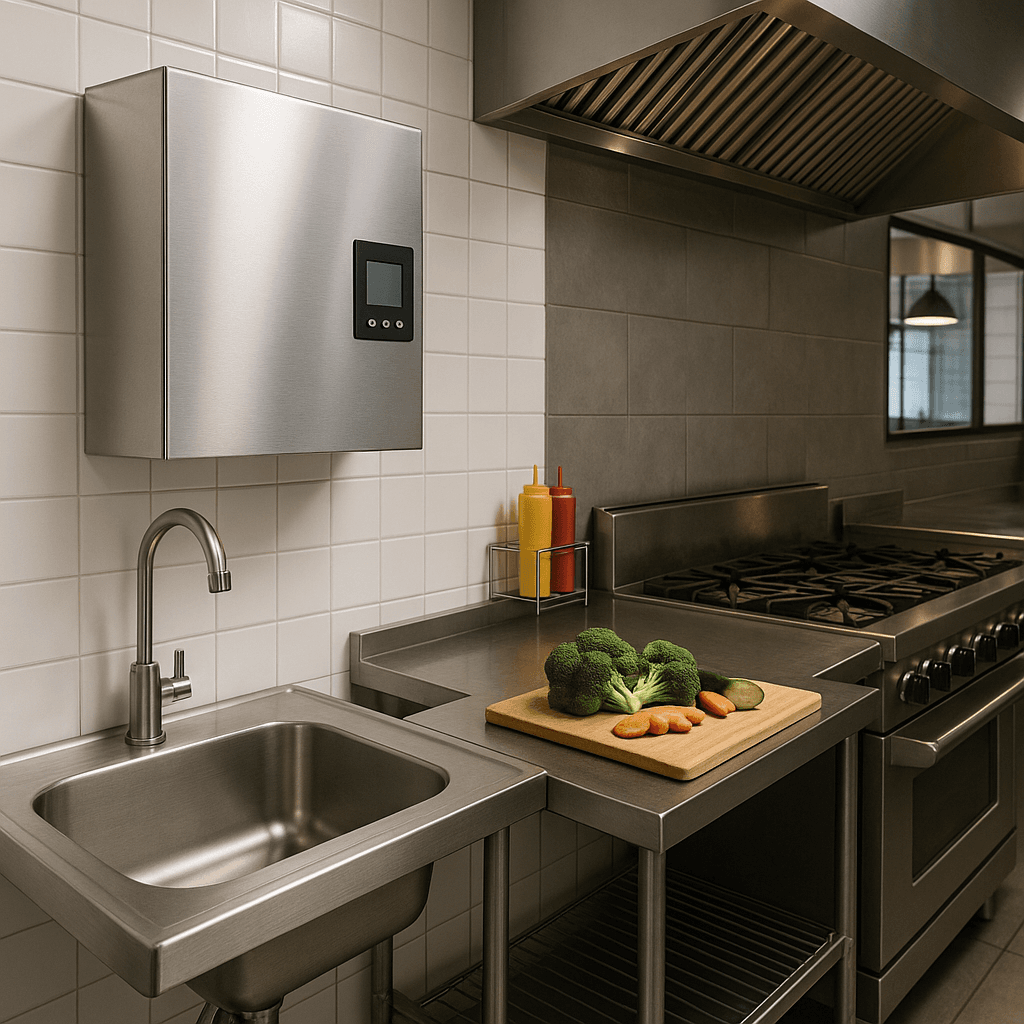
Water is an ingredient, a cleaning agent and the raw material for every cube of ice a restaurant serves. That is why UAE food safety rules say a good deal about where it comes from, how it is stored and how the equipment that treats it is looked after. This guide sets out what the published rules actually require of restaurants, hotels and cafes, with a focus on Dubai, where the most detailed guidance is published, and explains how filtration and maintenance fit in.
It is a practical summary, not legal advice. Always check the current version of each document with the authority that issues it.
Table of Contents
- Who Sets the Rules
- Key Technical Requirements
- Planning Your Compliance Work
- Sustainability Benefits
- Practical Steps for UAE Hospitality Businesses
Who Sets the Rules
There is no single "water filtration law" for UAE restaurants. Instead, the requirements come from food safety law and from technical guidance issued by the emirate-level authorities.
Federal food safety law: Federal Law No. 10 of 2015 on Food Safety sets the national framework for food safety across the Emirates. Enforcement is carried out locally, for example by Dubai Municipality in Dubai and the Abu Dhabi Agriculture and Food Safety Authority (ADAFSA) in Abu Dhabi.
The drinking water standard: Dubai Municipality's guidance on unbottled drinking water uses UAE.S GSO 149:2021 as the quality standard that water in buildings must meet.
Dubai Municipality guidance: For food businesses in Dubai, three documents matter most:
- The Dubai Municipality Food Code, which covers water supply, storage tanks, ice and equipment in food establishments.
- The Technical Guidelines for Quality of Unbottled Drinking Water, which apply to buildings such as hotels and commercial premises and cover testing, filters, water coolers and ice machines.
- The Technical Guidelines for Legionella Control in Water Systems, which cover risk assessment and temperature control.
If you operate in another emirate, check the equivalent requirements with the local food safety authority. The principles are similar, but the detail and the inspection regime can differ.
Key Technical Requirements
Water supply and storage (Dubai Food Code):
-
Drinking water must come from a source approved by Dubai Municipality or DEWA.
-
Water tanks must be covered and protected from contamination.
-
Tanks must be cleaned and disinfected at least twice a year by a company approved by the Food Control Department. Where a tank is shared, for example in a mall, the food business should hold documented evidence that the cleaning has been done.
-
Ice that comes into contact with food or drink must be made from drinking water.
-
Drinking water coolers and dispensers must be cleaned regularly.
Equipment design (Dubai Food Code):
-
Water filters must be designed so they can be taken apart easily for servicing.
-
Backflow prevention devices must be fitted wherever they are required, so dirty water cannot flow back into the supply.
-
Carbonation equipment that uses CO2 needs a check valve to stop carbonated water flowing back into the water line.
Water quality and testing (Unbottled Drinking Water guidelines):
-
Water must meet UAE.S GSO 149:2021.
-
Water should be tested by an EIAC-accredited laboratory every six months.
-
Residual free chlorine should be kept between 0.2 and 0.5 mg/L.
-
The building should have a water safety plan based on a risk assessment.
-
Records should be kept for five years.
Filters, coolers and ice machines (Unbottled Drinking Water guidelines):
-
Filtration systems need a certificate of conformity, such as the Emirates Quality Mark or another recognised mark, and must be maintained in line with the manufacturer's instructions.
-
Water coolers should meet UAE.S GSO 1811 and be cleaned and disinfected every six months.
-
Ice machines should be checked monthly. Removable parts, including water filters, should be cleaned quarterly, the machine sanitised every six months, and the ice tested for microbiological quality every six months.
Legionella control (Legionella guidelines):
-
Carry out a Legionella risk assessment of the water system.
-
Store hot water at 60°C or above and deliver it at 50°C or above.
-
Keep cold water below 20°C.
-
Flush or disinfect the system every six months.
In practice, filters are covered by these rules in two ways: they must be certified and maintained properly, and a filter that is not changed on time can become a source of contamination rather than a barrier to it. Scheduled maintenance with dated service records is the simplest way to show an inspector that both points are covered.
Planning Your Compliance Work
These requirements are already in force, so the aim is to close any gaps now rather than work towards a future deadline. A sensible order of work:
1. Review what you have: List every water outlet, tank, filter, cooler, ice machine and coffee or beverage system. Note who owns and cleans any shared tanks.
2. Check the records: Confirm you have tank cleaning certificates, laboratory test reports, filter change dates and ice machine cleaning logs. Missing paperwork is one of the easiest gaps to spot and fix.
3. Test the water: Book testing with an EIAC-accredited laboratory if you do not have recent results, and test at the points of use as well as at the tank.
4. Fix equipment issues: Replace uncertified or overdue filters, add backflow protection where it is missing and bring hot and cold water temperatures into line.
5. Set a routine: Put six-monthly, quarterly and monthly tasks into a written schedule with named owners, and keep every record for at least five years.
Things to plan around in the UAE:
-
Seasonal timing: Schedule larger installations during quieter trading periods to limit disruption.
-
Lead times: Allow time for specialist equipment and qualified installers, particularly if equipment is imported.
-
Multilingual teams: Provide procedures and training in the languages your staff use.
Sustainability Benefits
Good on-site filtration also supports sustainability goals. Serving filtered water instead of bottled water cuts single-use plastic, removes bottle deliveries and storage, and reduces waste handling. These benefits support the UAE's wider sustainability agenda, including the UAE Net Zero by 2050 Strategic Initiative and Dubai's phased ban on single-use products under Executive Council Resolution No. 124 of 2023, and give hotels and restaurants clear evidence for sustainability reporting and certification schemes such as Green Key.
Practical Steps for UAE Hospitality Businesses
1. Audit your water system
-
Map all water access points and usage areas throughout your establishment
-
Identify critical applications, such as ice, coffee and beverage dispensing, with specific water quality needs
-
Document current filtration systems and their certification
-
Test water quality at several points to identify variation across the venue, particularly in older buildings
2. Write a simple specification
-
Set out the filtration each application needs
-
Identify integration requirements with existing plumbing, including backflow protection
-
Define maintenance access in space-constrained kitchens
3. Choose equipment with the whole life cost in mind
-
Compare initial equipment costs with ongoing filter and service costs
-
Base filter change intervals on your local water and usage volume
-
Check that equipment carries a recognised certificate of conformity
-
Confirm manufacturer support and warranty are available within the UAE
4. Train your team
-
Write standard operating procedures in the languages your team uses
-
Give named staff clear responsibility for cleaning, testing and record keeping
-
Include water checks in your existing food safety routines
5. Keep your records inspection-ready
-
Keep digital or paper logs of all maintenance and cleaning
-
File laboratory test results, tank cleaning certificates and equipment certificates together
-
Keep records for at least five years
6. Work with an experienced supplier
-
Choose a provider with a local presence and hospitality experience
-
Consider a maintenance contract so filter changes and servicing happen on schedule
7. Plan for disruption
-
Keep spare filters and key consumables on site
-
Agree procedures for water supply interruptions
-
Increase checks during dusty periods, when filters can load up faster
Conclusion
UAE water rules for hospitality are practical: approved supply, clean tanks, safe ice, certified and well-maintained filters, regular testing and good records. None of this is new, but it is easy for paperwork and filter changes to slip in a busy operation. A clear schedule and a reliable maintenance partner keep your venue compliant and protect the quality of every drink and dish you serve.
Sources
- Dubai Municipality: Food Code (2013)
- Dubai Municipality: Technical Guidelines for Quality of Unbottled Drinking Water, DM-HSD-GU17-DW2
- Dubai Municipality: Technical Guidelines for Legionella Control in Water System, DM-HSD-GU44-LCWS2
- UAE Ministry of Climate Change and Environment: Federal Law No. 10 of 2015 on Food Safety
- UAE Government: The UAE's Net Zero 2050 Strategy
- Dubai Supreme Legislation Committee: Resolution regulating single-use products in Dubai
Talk to our team about your UAE site, application, water requirements and operating conditions.